The Advertising Industry Is Not “Adapting” to AI. It’s Rebuilding Around It.
Artificial intelligence is no longer an add-on tool in advertising. It’s restructuring entire agency models from the inside out.
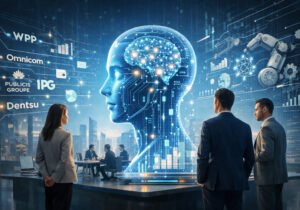
Global holding companies like WPP, Publicis Groupe, Omnicom Group, Interpublic Group, and Dentsu are restructuring operations, consolidating agencies, investing heavily in AI platforms, and redefining workforce structures.
This isn’t cosmetic change. It’s structural.
The question isn’t whether AI is important. The question is why the largest advertising networks are reorganizing their business models around it.
1. Margin Pressure Is Forcing Automation
Large holding companies operate on complex, multi-layered cost structures. Talent-heavy models, fragmented agency brands, and traditional billing systems have compressed margins over the last decade.
AI addresses this in three direct ways:
- Automating production workflows
- Reducing repetitive creative tasks
- Improving media buying efficiency
When AI can generate variations of creative, analyze performance in real time, and optimize ad placements algorithmically, the economics of scale change dramatically.
Restructuring allows holding companies to centralize AI infrastructure instead of duplicating capabilities across dozens of agencies.
This is about profitability as much as innovation.
2. Clients Now Expect AI-Enabled Performance
Enterprise clients are no longer impressed by process. They expect measurable outcomes.
AI-driven marketing enables:
- Predictive media allocation
- Real-time budget optimization
- Hyper-personalized campaigns
- Automated performance reporting
Holding companies are reorganizing to integrate data science, media buying, and creative under unified AI platforms.
Why? Because siloed agencies cannot compete with integrated intelligence systems.
Clients want faster iteration cycles and clearer ROI.
3. Data Is Becoming the Core Asset
Historically, agencies competed on creative talent.
Now they compete on data infrastructure.
AI models rely on:
- First-party customer data
- Behavioral analytics
- Cross-channel performance signals
- Machine learning optimization
Holding companies are restructuring to build centralized data ecosystems rather than isolated agency databases.
Data consolidation improves:
- Targeting accuracy
- Attribution modeling
- Long-term customer insights
Without structural change, AI cannot operate effectively at scale.
4. The Creative Process Is Being Redefined
AI is not replacing creativity. But it is redefining how creative is produced.
Instead of long production cycles, agencies can now:
- Generate multiple creative directions quickly
- Test variants instantly
- Refine messaging based on real-time feedback
This compresses timelines significantly.
Restructuring allows agencies to integrate AI into the creative workflow rather than bolt it on at the end.
But there’s tension here.
When everyone uses similar AI tools, differentiation becomes harder. That’s a strategic risk holding companies must manage carefully.
5. Workforce Realignment and Skill Shifts
AI transformation inevitably changes talent requirements.
Holding companies are investing more in:
- Data engineers
- Machine learning specialists
- AI strategy consultants
- Automation architects
Traditional roles are evolving.
The restructuring isn’t only about cutting costs. It’s about reallocating expertise toward higher-leverage functions.
Agencies that fail to upgrade their talent stack risk irrelevance.
6. Consolidation for Simplicity
Many large advertising groups historically operated dozens of sub-brands under one umbrella.
AI integration favors simplicity.
Centralized platforms require:
- Unified processes
- Shared technology stacks
- Integrated reporting systems
Restructuring often means merging agencies, removing redundancies, and creating unified service offerings built around AI-enabled performance.
This reduces operational complexity and strengthens competitive positioning.
What This Means for Brands
For brands, this shift has both benefits and implications.
Benefits:
- Faster campaign execution
- Improved targeting accuracy
- Lower production timelines
- Stronger performance optimization
Implications:
- Greater reliance on data transparency
- Increased pressure for measurable ROI
- Reduced tolerance for vague creative justification
Brands will increasingly evaluate agencies on technical infrastructure as much as creative capability.
What This Means for Independent Agencies
Here’s where it gets interesting.
Independent and mid-sized agencies are not competing on global scale. They compete on speed, agility, and specialization.
AI lowers entry barriers.
With the right systems, smaller agencies can now:
- Access advanced automation tools
- Deliver predictive insights
- Optimize campaigns efficiently
But there’s a catch.
Without strategic positioning, AI simply turns smaller agencies into cheaper production vendors.
The advantage lies in combining AI capability with sharp strategic thinking.
The Bigger Shift: Agencies Are Becoming Technology Companies
Advertising is no longer just creative storytelling.
It’s becoming a technology-enabled growth engine.
Holding companies are restructuring because:
- AI improves margins
- AI increases scalability
- AI strengthens data ownership
- AI enhances predictive decision-making
The agency model is evolving from service provider to intelligence partner.
That’s a fundamental shift.
The Risk of Over-Industrialization
There’s an emerging risk no one talks about enough.
If every major agency optimizes around the same AI frameworks, output begins to converge.
Performance may improve. Originality may decline.
And brand differentiation depends on originality.
Holding companies must balance automation with human-led strategic vision.
Otherwise efficiency wins, but uniqueness disappears.
Final Thoughts: AI Is Reshaping the Power Structure of Advertising
The restructuring of global ad holding companies is not a reaction to hype. It’s a response to structural market pressure.
AI is transforming:
- Cost structures
- Talent requirements
- Client expectations
- Competitive advantage
The agencies that win will not be the ones with the most tools.
They will be the ones that integrate AI into a coherent growth system.
Because in the end, technology amplifies strategy.
And without strategy, amplification just scales mediocrity.